The Seconds Hand Is Gone. The Carrera Team Ikuzawa Is All the More Legible for It.
TAG Heuer and Team Ikuzawa strip the chronograph back to its essentials—a white dial, red accents, and a 39mm Glassbox case—to create a reference that is as much about design heritage as it is about timekeeping.

Image: revolution.watch
A Dial That Asks You to Look Twice
Some watches win you over before you’ve even checked the movement. The new TAG Heuer Carrera Chronograph x Team Ikuzawa is one of them. The first impression is a white dial with sharp red accents, a combination that immediately reads as both vintage and modern. But the real audacity is what’s missing: the running seconds hand. It’s a decision that will divide purists who want to see the movement’s pulse at all times. Yet here, its absence is exactly what makes the watch work. The negative space allows the signature Team Ikuzawa branding at 6 o’clock to breathe, while the printed indices take on a graphic quality reminiscent of the Roadmaster chronographs that were a regular presence in Japanese motorsport during the seventies and eighties. This is not a watch that merely adds color; it subtracts an element to achieve a more powerful composition. The focus shifts to the chronograph function itself, making the act of timing something feel more deliberate and precise.
From Racing Team to Creative Studio
Team Ikuzawa is not a nostalgia act. Founded by legendary Japanese driver Tetsu Ikuzawa, the team is now led by his daughter Mai Ikuzawa, who has transformed it into a multifaceted creative studio. It operates at the intersection of motorsport, fashion, and design, preserving automotive history for a new generation. They are as likely to collaborate with a high-end fashion house as they are to appear at a classic car meet. This evolution makes them a natural partner for George Bamford, whose Bamford Watch Department has spent two decades reimagining established objects without losing sight of what made them icons. "When I think about collaborations, they should lead you in a new direction and introduce a new language of design," Bamford explains. The inspiration for this project didn't come from a modern racing car but from a vintage Roadmaster chronograph that has hung on his wall for years. This object, once a common feature in Japanese motorsport, provided the foundation for a new visual identity for the Carrera.
Framing a Legacy, Not Rebuilding It
Jack Heuer’s original 1963 Carrera was designed with a singular purpose: legibility. A wide dial opening, clear typography, and a balanced layout were meant to communicate elapsed time instantly during the chaos of a race. The Roadmaster chronometers used by Team Ikuzawa solved the exact same problem. This shared goal is why the collaboration feels less like a costume and more like a natural evolution. Bamford’s approach was to frame this heritage from a different angle. "I wouldn't touch the movement," he states. "The Carrera is one of the definitive chronographs, and Jack Heuer created a legacy for TAG Heuer." The result is a watch that respects the mechanical foundation of the Carrera while introducing a new graphic identity, drawn from a specific piece of motorsport history. It’s a strategy of restraint, a refusal to try and outdo the original, and instead, an attempt to show it in a new light.
A Graphic Language Built on 39 Millimeters
The 39mm Glassbox case is crucial to the success of this design. The edge-to-edge crystal and minimal bezel profile maximize the dial space, allowing the graphics to take center stage. The printed indices directly reference vintage timing instruments, while the red accents are a deliberate nod to the Team Ikuzawa colors found on their Roadmaster equipment. Bamford is clear about his philosophy: "The three straps, the red on the crown, the toolbox-style case—all these elements pushed us toward what I would call a new language for the Carrera." This language is less about novelty and more about a careful selection of historical details. The watch doesn't scream for attention; it invites closer inspection. The choice of a 39mm width, as opposed to a more contemporary larger size, further enhances the vintage feel while maintaining the ergonomic comfort that has made the Carrera a lasting favorite.
An Homage With a Clear Point of View
Modern collaborations often feel like logo-swapping exercises designed to generate hype. The Carrera x Team Ikuzawa works because every decision has a root in real automotive history and is executed with remarkable care. George Bamford’s two decades of experience have taught him that the most compelling work often comes from knowing what to leave alone. By pairing the iconography of the Roadmaster with the unaltered architecture of the Carrera, this piece honors the design language of those who built the scene, rather than simply paying lip service to it. It’s a chronograph that looks toward the past while contributing something genuinely new to the collection. The debate over the missing seconds hand will likely continue, but the watch itself has already made its case. This is a timepiece with a point of view, a specific historical reference, and an immediate, undeniable coolness that gets to the heart of why we love these objects.
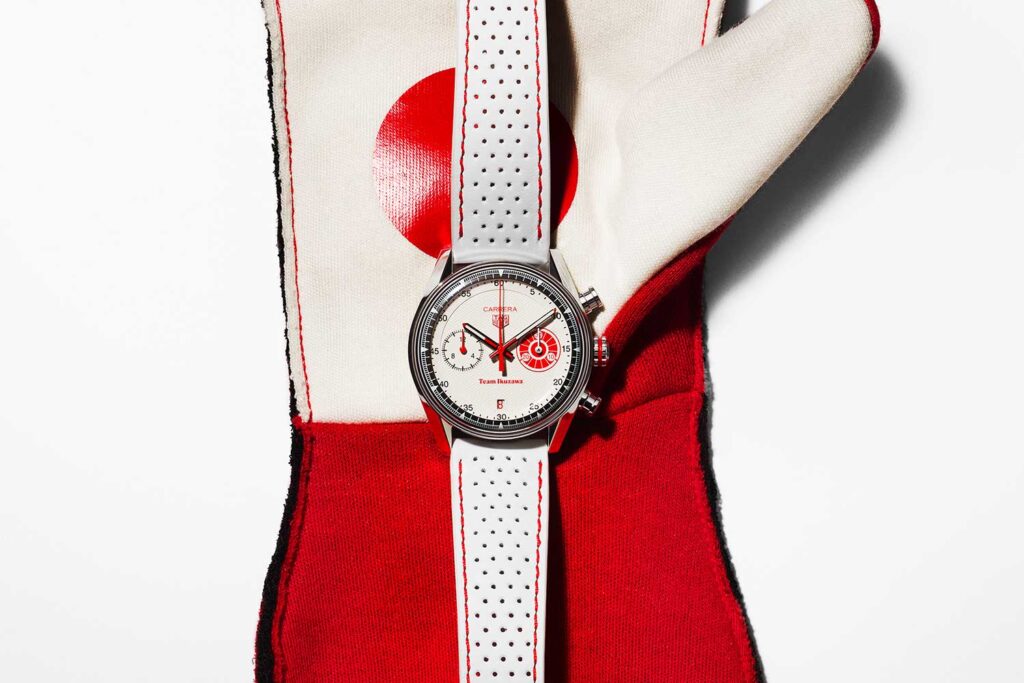
Image: revolution.watch

Image: revolution.watch
Image: revolution.watch
Draws on source material published at revolution.watch.
Keep reading

What Your Cashmere Price Tag Actually Buys
We went to the mills of Northern Italy to find out why one sweater costs $295 and another costs $29 — and what you get for the difference.
Eight Contradictions That Define the Field Watch
From the spec that created a genre to the skeleton that rejects minimalism, these tensions explain why the field watch feels so right on the wrist.

Fall's Biggest Print Is Deer—and Pencil Skirts Are Going Flowy
From Target shelves to campus coffee shops, the season's trends are a mash-up of nostalgia and new proportions.