The Zestier Basic: Why Your Wardrobe Staples Need One Deliberate Twist
Forget the perfect white tee—fashion's sharpest dressers are reaching for the asymmetric tank, the heather-gray jean, the quarter-sleeve baseball top in sky blue instead.
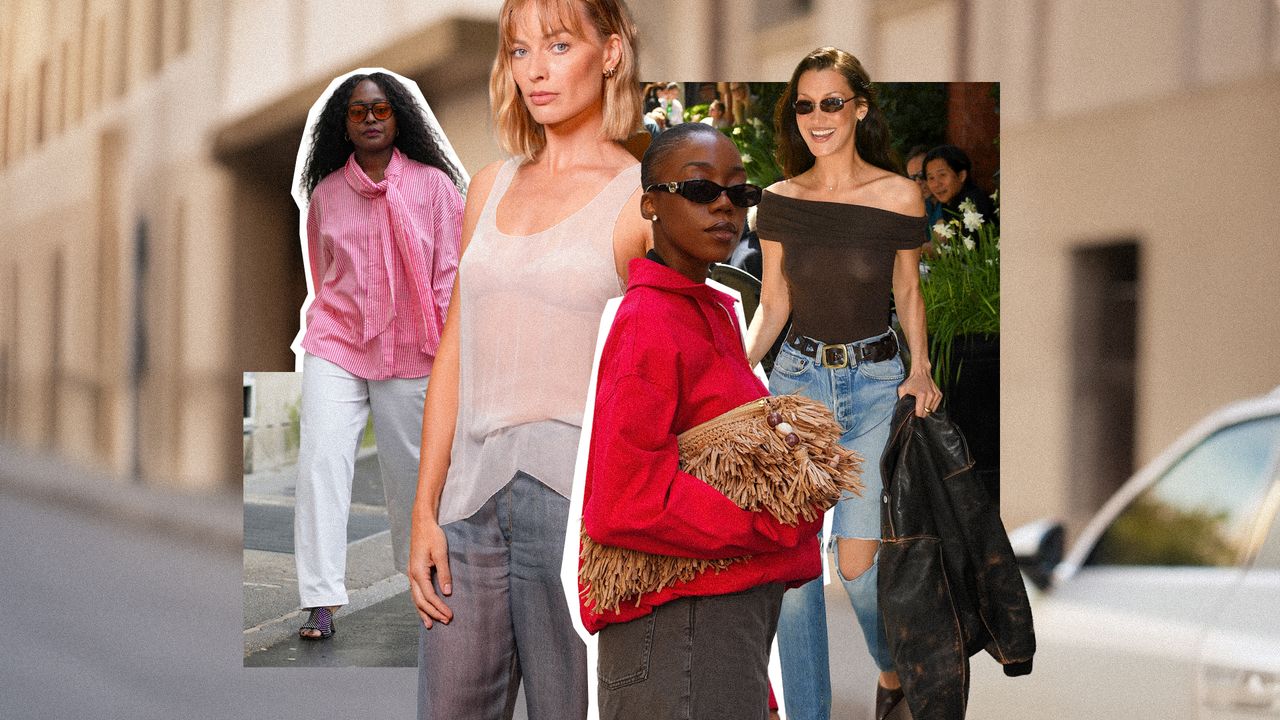
Image: glamour.com
One Detail, Maybe Two—Never Three
A good zestier basic still reads as a wardrobe essential at a glance. The moment it crosses into territory that requires explanation, it becomes a going-out piece. A tank with one keyhole cutout sits comfortably in the staples drawer; a tank with three cutouts is clubwear. Palazzo-width jeans in a rigid denim read costume-y next to a straight-leg pair in the same murky gray wash. The working guideline among editors is to look for one design detail, two at most: a ruched waistline, an unexpected textile like pointelle cotton, a high collar on an otherwise standard button-down. Cou Cou Intimates offers cotton pointelle tanks and raglan tees; Cos carries high-collared and sheer button-downs—examples that sit squarely in the recognizably-basic camp while carrying enough texture to hold their own without layering armor. The restraint is the point. One twist reads intentional. Three reads confused.
Blazy's Chanel Debut Proves the Principle at Luxury Scale
Mathieu Blazy's Spring/Summer 2026 debut at Chanel offered a masterclass in threading zest through heritage codes without unraveling them. Crisp tuxedo shirts, embroidered with the Chanel name and produced in partnership with Charvet—the French shirting house—arrived as instant standouts. The silhouette was pure dress-shirt: spread collar, buttoned cuffs, structured placket. The embroidery was the single deviation, and it landed precisely because everything else held steady. Blazy applied the same logic to footwear. Animal-print pony hair shoes from the collection are selling exceptionally well, driven partly by a celebrity cohort that has quietly rotated out of the black and beige Chanel ballet flats. Dua Lipa has been photographed repeatedly in a maroon-and-baby-blue colorway, a combination that reads playful without abandoning the flat's ballet-slipper DNA. The through-line is restraint in service of personality—exactly the quantity that separates a wardrobe with range from one with rules.
Translating the Principle Beyond the Luxury Bubble
The Chanel price point is not the point. The philosophy scales directly to the J.Crew tank aisle and the weekday-morning scramble. A ribbed cotton tank in terracotta rather than white, a crewneck sweater in a marled oatmeal knit instead of flat navy, a straight-leg chino in a washed olive that reads almost gray—each one a basic that earns its hanger space while adding a degree of visual texture the standard-issue version cannot. The shopping filter is mechanical: scan the category (tank, tee, jean, button-down), then scan for the single variable that distinguishes the piece from the default. If the variable is a color outside the expected neutral range, that qualifies. If it is a fabric shift—pointelle for flat jersey, heathered yarn for solid dye—that qualifies too. If the piece requires a second variable to justify its existence, it has crossed the line into statement territory, and statement pieces are not basics, no matter how simple the cut. Keep the category, swap the detail, walk out the door.
Why the Closet Benefits From Controlled Deviation
A wardrobe built entirely on safe defaults produces outfits that are correct and forgettable. A wardrobe built entirely on statement pieces produces outfits that are loud and exhausting. The zestier-basic approach occupies the narrow band between those poles: enough visual interest to register as intentional, enough restraint to mix across contexts without requiring a costume change. The math is additive. Ten basics with one twist each generate the same outfit permutations as ten plain basics, but the resulting combinations carry a texture and specificity the plain set cannot match. A heather-gray jean pairs with the same white tee as an indigo one, but the gray version shifts the entire palette toward cooler, more muted territory without requiring a single additional purchase. The asymmetric tank layers under the same blazer as the standard two-strap, but the exposed single strap becomes a focal point the blazer's lapels frame rather than hide. The wardrobe does not grow larger. It grows more deliberate.
Draws on source material published at glamour.com.
Keep reading
What Your Cashmere Price Tag Actually Buys
We went to the mills of Northern Italy to find out why one sweater costs $295 and another costs $29 — and what you get for the difference.
Eight Contradictions That Define the Field Watch
From the spec that created a genre to the skeleton that rejects minimalism, these tensions explain why the field watch feels so right on the wrist.
Fall's Biggest Print Is Deer—and Pencil Skirts Are Going Flowy
From Target shelves to campus coffee shops, the season's trends are a mash-up of nostalgia and new proportions.